
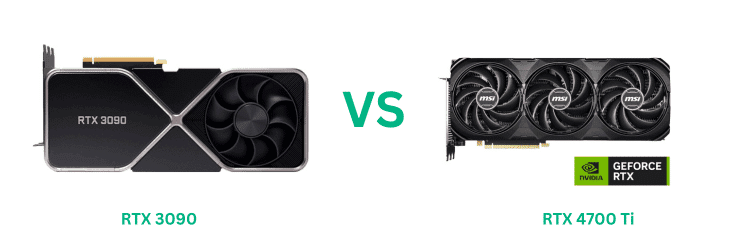
RTX 4070 Ti & 3090 share many similarities, but there are also important differences, such as quality, performance, features, and connectivity. If you want the best one between them, I Would recommend the RTX 3090 rather than the RTX 4070 Ti.
Why Do I Recommend The Nvidia RTX 3090?
- The Nvidia RTX 3090’s 10,496 CUDA cores boost in processing power for smooth frame rates, rendering large scenes, executing complex simulations & efficiently handling multiple tasks at once compared to the 7,680 cores of the RTX 4070 Ti.
- Nvidia RTX 3090 delivers 69.5 RT TFLOPs, providing more realistic lighting, shadows, and reflections in complex, ray-traced environments compared to the 51 RT TFLOPs of the RTX 4070 Ti.
- It has a larger 24GB GDDR6 memory for high-resolution gaming and content creation compared to the Nvidia RTX 4070 Ti’s 12GB GDDR6X.
- Nvidia RTX 3090 has a memory bandwidth of 936 GB/s for smoother gameplay and quicker load times, while the RTX 4070 Ti’s 504 GB/s delivers data slowly.
- The RTX 3090 offers 384-bit memory bus width for handling large datasets and improving overall rendering speed in demanding 3D applications, compared to the 192-bit bus of the RTX 4070 Ti.
- It offers 328 TMUs processing power that translates to richer textures and more detailed environments in high-end games and 3D rendering compared to 240 in the RTX 4070 Ti.
- The RTX 3090 has 3 HDMI ports that give flexibility for multi-display setups & connect multiple high-resolution monitors. In contrast, the RTX 4070 Ti has only 1 HDMI port.
Maybe the RTX 4070 Ti price can make you comfortable because it’s a little bit cheaper than the RTX 3090. But you have to compromise all the above-mentioned features. Now the Decision is Yours. I hope it was helpful to choose the right one.
.
Side By Side Comparison
| Feature | Nvidia RTX 3090 | Nvidia RTX 4070 Ti |
| GPU Architecture | Ampere (GA102) | Ada Lovelace (AD104) |
| CUDA Cores | 10,496 | 7,680 |
| Boost Clock Speed | 1.70 GHz | 2.61 GHz |
| Base Clock Speed | 1.40 GHz | 2.31 GHz |
| Memory | 24 GB GDDR6X | 12 GB GDDR6X |
| Memory Speed | 19.5 Gbps | 21 Gbps |
| Memory Interface Width | 384-bit | 192-bit |
| Total Memory Bandwidth | 936.2 GB/s | 504.2 GB/s |
| Ray Tracing Cores | 82 | 60 |
| Tensor Cores | 328 | 240 |
| Transistor Count | 28.3 billion | 35.8 billion |
| Power Consumption (TDP) | 350 W | 285 W |
| Process Technology | 8nm | 4nm |
| Tensor Float (TF32) | 35.6 TFLOPs | 40.1 TFLOPs |
| Ray Tracing Performance (RT TFLOPs) | 69.5 TFLOPs | 51 TFLOPs |
| DLSS Version | DLSS 2.0 | DLSS 3.0 |
| Maximum GPU Temperature | 93°C | 90°C |
| Price | Check RTX 3090 Price | Check 4070 Ti Price |
What Common Both Can Do?
- Nvidia’s Cutting-Edge Technology: Both the Nvidia GeForce RTX 3090 and RTX 4070 Ti are manufactured by Nvidia, meaning they both benefit from Nvidia’s advanced innovations in GPU technology. Both cards leverage Nvidia’s Ampere and Ada Lovelace architectures (respectively), which introduce features like RT cores for ray tracing, Tensor cores for AI-based computations, and DLSS technology for AI-enhanced game performance.
- PCIe 4.0 Interface: Both cards are built to operate on the PCIe 4.0 interface, providing ample bandwidth for gaming, content creation, and other high-performance tasks. This ensures that both GPUs communicate quickly with the CPU and other system components, reducing bottlenecks and allowing for faster data transfer.
- DLSS Technology: Both cards support DLSS (Deep Learning Super Sampling), Nvidia’s AI-driven technology that boosts performance by upscaling lower-resolution frames to higher resolutions while maintaining image quality. Although the RTX 4070 Ti benefits from DLSS 3.0, both cards offer this feature, allowing for smoother gameplay at higher resolutions.
- VR Ready: Both the RTX 3090 and RTX 4070 Ti are fully VR Ready, meaning they are optimized for use with virtual reality headsets. This ensures smooth and immersive VR experiences, with enough power to drive high-refresh-rate VR displays and render complex scenes in virtual worlds.
- 8K Gaming and Display Support: Both cards are capable of supporting 8K resolution (7680 x 4320), although the RTX 3090 is more suited to the task due to its larger memory pool. However, both GPUs can handle 8K displays via HDMI 2.1, making them versatile for content creators and gamers who want to push the boundaries of resolution.
- HDMI 2.1 and DisplayPort 1.4a: Both the RTX 3090 and RTX 4070 Ti include HDMI 2.1 and DisplayPort 1.4a outputs, supporting high-resolution displays and high-refresh-rate monitors. HDMI 2.1 enables 8K/60Hz or 4K/
- G-Sync Support: Both GPUs support Nvidia G-Sync, a technology designed to eliminate screen tearing and reduce input lag. By synchronizing the refresh rate of the monitor with the frame rate of the GPU, both the RTX 3090 and RTX 4070 Ti ensure smooth gameplay and a more immersive experience, particularly in fast-paced games.
- Real-Time Ray Tracing: Real-time ray tracing is a feature available on both the RTX 3090 and RTX 4070 Ti, utilizing dedicated RT cores to compute realistic lighting, shadows, and reflections. This technology enhances the visual quality in games and applications that support ray tracing, making both GPUs highly capable of delivering cutting-edge graphics in modern games.
- Game Ready Drivers: Both GPUs benefit from Nvidia Game Ready Drivers, which are designed to optimize performance for the latest games on the day of their release. These drivers ensure that both the RTX 3090 and RTX 4070 Ti are always up to date with the latest game optimizations and bug fixes, allowing gamers to enjoy the best possible performance and stability.
- DirectX 12 Ultimate and Vulkan API Support: Both GPUs are fully compatible with DirectX 12 Ultimate and the Vulkan API, offering advanced graphical features such as ray tracing, variable rate shading, and mesh shaders. These APIs allow game developers to take full advantage of the hardware capabilities of both the RTX 3090 and RTX 4070 Ti, resulting in better graphics and smoother performance in modern games.
- Nvidia Reflex: Both GPUs support Nvidia Reflex, a technology designed to reduce system latency in competitive games. This gives gamers a faster response time by optimizing the rendering pipeline, allowing both the RTX 3090 and RTX 4070 Ti to provide a competitive edge in fast-paced gaming environments.
- NVENC Encoder: The Nvidia NVENC Encoder is included in both GPUs, allowing for efficient hardware-based video encoding. This feature is particularly useful for streamers, content creators, and video editors, as it allows for high-quality video recording or streaming with minimal impact on game or application performance.
RTX 4070 ti vs 3090 Common Features
| Feature | Nvidia RTX 3090 | Nvidia RTX 4070 Ti |
| GPU Manufacturer | Nvidia | Nvidia |
| PCIe Interface | PCIe 4.0 | PCIe 4.0 |
| Tensor Cores | Yes | Yes |
| VR Ready | Yes | Yes |
| 8K Resolution Support | Yes | Yes |
| HDMI Version | HDMI 2.1 | HDMI 2.1 |
| DisplayPort Version | DisplayPort 1.4a | DisplayPort 1.4a |
| G-Sync Support | Yes | Yes |
| Real-Time Ray Tracing | Yes | Yes |
| CUDA Support | Yes | Yes |
| DirectX Support | DirectX 12 Ultimate | DirectX 12 Ultimate |
| Vulkan Support | Yes | Yes |
| OpenGL Support | Yes (Version 4.6) | Yes (Version 4.6) |
| OpenCL Support | Yes (Version 3.0) | Yes (Version 3.0) |
| Nvidia Reflex | Yes | Yes |
| Max Digital Resolution | 7680 x 4320 (8K) | 7680 x 4320 (8K) |
| GPU Boost Technology | Yes | Yes |
| Ansel Support | Yes | Yes |
| NVENC Encoder | Yes | Yes |
| Game Ready Drivers | Yes | Yes |
| CUDA Compute Capability | 8.6 | 8.9 |
| Resizable BAR Support | Yes | Yes |
| AV1 Decode Support | Yes | Yes |
| Price | Check RTX 3090 Price | Check 4070 Ti Price |
FAQ
Q: Which GPU is better for 8K gaming? A: The Nvidia GeForce RTX 3090 is better suited for 8K gaming due to its 24 GB of VRAM, 384-bit memory bus, and higher memory bandwidth of 936.2 GB/s, which helps handle the larger memory demands of 8K gaming. While the RTX 4070 Ti supports 8K resolution, it may struggle with more demanding 8K titles due to its 12 GB of VRAM and lower memory bandwidth. Q: How do the CUDA core counts compare between the two GPUs? A: The RTX 3090 has 10,496 CUDA cores, while the RTX 4070 Ti has 7,680 CUDA cores. This means the RTX 3090 is more powerful for tasks that require parallel processing, such as 3D rendering, scientific simulations, and video encoding. The 4070 Ti compensates with higher clock speeds, making it more efficient for gaming. Q: Do both GPUs support ray tracing? A: Yes, both the Nvidia GeForce RTX 3090 and RTX 4070 Ti support ray tracing through their dedicated RT cores. The RTX 3090 features 82 RT cores, while the RTX 4070 Ti has 60 RT cores. Although the RTX 3090 has more RT cores, the RTX 4070 Ti uses a newer architecture that optimizes ray tracing performance, making it competitive in ray-traced games. Q: Which GPU is more power efficient? A: The RTX 4070 Ti is more power-efficient, with a TDP of 285W compared to the RTX 3090’s 350W. The 4070 Ti benefits from the more advanced Ada Lovelace architecture, which is built on a 4nm process, allowing for better performance-per-watt. This makes the RTX 4070 Ti more suitable for builds with power constraints or smaller cooling solutions. Q: Are both GPUs VR Ready? A: Yes, both the RTX 3090 and RTX 4070 Ti are VR Ready. They have the required processing power and video outputs (HDMI 2.1, DisplayPort 1.4a) to support smooth virtual reality experiences. Both can drive high-refresh-rate VR headsets with high graphical fidelity. Q: What is the price difference between the RTX 3090 and RTX 4070 Ti? A: The RTX 3090 was launched with a much higher price point of $1,499 compared to the RTX 4070 Ti, which debuted at $799. The RTX 4070 Ti offers a more affordable option for gamers who want high-end performance without the extra memory and professional features of the RTX 3090. Q: Which card has better DLSS support? A: The RTX 4070 Ti supports DLSS 3.0, which introduces Frame Generation and improved AI-driven upscaling for smoother performance, especially in demanding titles. The RTX 3090 supports DLSS 2.0, which is still highly capable but lacks the Frame Generation feature found in DLSS 3.0. For modern gaming, the 4070 Ti offers superior DLSS performance. Q: Are both GPUs compatible with PCIe 4.0? A: Yes, both the RTX 3090 and RTX 4070 Ti are compatible with PCIe 4.0. This ensures fast communication between the GPU and other system components, such as the CPU and storage devices, minimizing bottlenecks and maximizing performance. Q: Can both GPUs handle multiple high-resolution displays? A: Yes, both the RTX 3090 and RTX 4070 Ti are capable of driving multiple high-resolution displays thanks to their HDMI 2.1 and DisplayPort 1.4a outputs. This makes them ideal for setups that require multiple monitors for gaming, productivity, or content creation at resolutions up to 8K. Q: Which GPU is better for streaming and content creation? A: Both GPUs include Nvidia’s NVENC encoder, making them great for streaming and content creation. However, the RTX 3090, with its larger 24 GB of VRAM and higher CUDA core count, is better suited for more intensive content creation tasks, such as 4K+ video editing, 3D rendering, and AI development. The RTX 4070 Ti is still highly capable but is more focused on gaming performance with sufficient power for light to moderate content creation. Q: What’s the best use case for each GPU? A: The RTX 3090 is best suited for professional users, such as content creators, 3D artists, and AI developers who need the extra memory and computational power for demanding workloads. On the other hand, the RTX 4070 Ti is designed for high-end gamers who want excellent performance at 4K or 1440p resolutions, leveraging DLSS 3.0 and ray tracing with greater power efficiency and a lower price tag. |